Transparency note
This article is a personal reflection, not an audit or a claim about the current financial performance of any named business. The dealership is intentionally anonymous. My perspective comes from more than twenty years as a customer, multiple vehicle purchases, long-term use of its service department, and earlier consulting work supporting kaizen, 5S, daily management, and customer-flow improvement.
Sometimes you do not need a dashboard to know that an organization has changed.
You feel it when you walk through the door.
The workplace is less clean than you remember. The greeting is less consistent. Employees appear busy, but the work does not flow. Customers wait without knowing what happens next. People move constantly, yet progress feels slow.
Nothing looks completely broken.
But almost everything feels slightly harder than it should.
I recently had that experience at a car dealership I have known for more than twenty years.
Over that time, I have bought vehicles there, returned for service, worked with its people, and watched the business pass through different stages of growth and leadership. Years ago, I also supported the dealership as a kaizen and continuous-improvement consultant.
That history matters because my reaction was not based on one disappointing visit.
I knew what the operation used to feel like.
And I could feel that something had changed.
When the workplace felt cared for
At its best, the dealership was not simply tidy.
It was intentional.
When customers arrived for service, someone coordinated the lanes. People generally knew where to go. Vehicles, tools, materials, and customer areas had defined places. New vehicles were presented carefully. The service side felt clean, orderly, and ready for the day.
The environment communicated competence before anyone explained the process.
That is easy to underestimate.
Customers may not use Lean language. They do not usually say, “This organization has strong visual management and well-designed flow.”
They say:
- “This place is organized.”
- “They know what they are doing.”
- “Someone took care of me.”
- “I knew what was happening.”
Good operational design becomes a feeling of trust.
What we were really trying to build
When I supported kaizen and 5S work there, the goal was never to create a showroom that looked good for one week.
The goal was to make the work easier to understand and easier to manage.
Where should an item be stored?
Who owns this area?
How should a customer move through the service process?
What should employees see when work begins to fall behind?
What condition requires escalation?
How should leaders respond before a small abnormality becomes a larger customer problem?
We also worked with elements of daily management.
That mattered because improvement cannot depend on occasional workshops. A kaizen event may discover a better method, but daily leadership determines whether that method survives.
The strongest improvement cultures are not held together by labels, floor markings, or meeting boards.
They are held together by attention.
Then the ownership changed
More recently, the dealership went through a significant ownership transition.
I do not have access to its current internal data, and I cannot claim that the ownership change caused every condition I observed. Transitions are complex. New owners inherit people, systems, facilities, commercial pressures, and priorities they did not create.
But the timing of the visible change was difficult to ignore.
The operation appeared to have more people.
It likely had more data, more reporting, and more administrative activity.
Yet it felt less coordinated.
There was more movement, but not always more progress.
There were more employees, but not necessarily better customer flow.
There was more activity, but also more waiting, searching, interruption, unclear handoffs, and idle time.
Some experienced people remained. That is important. But retaining knowledgeable individuals is not enough if the management system around them no longer supports the routines that made the operation work.
One person can carry knowledge.
One person cannot carry an operating culture alone.
The small signals
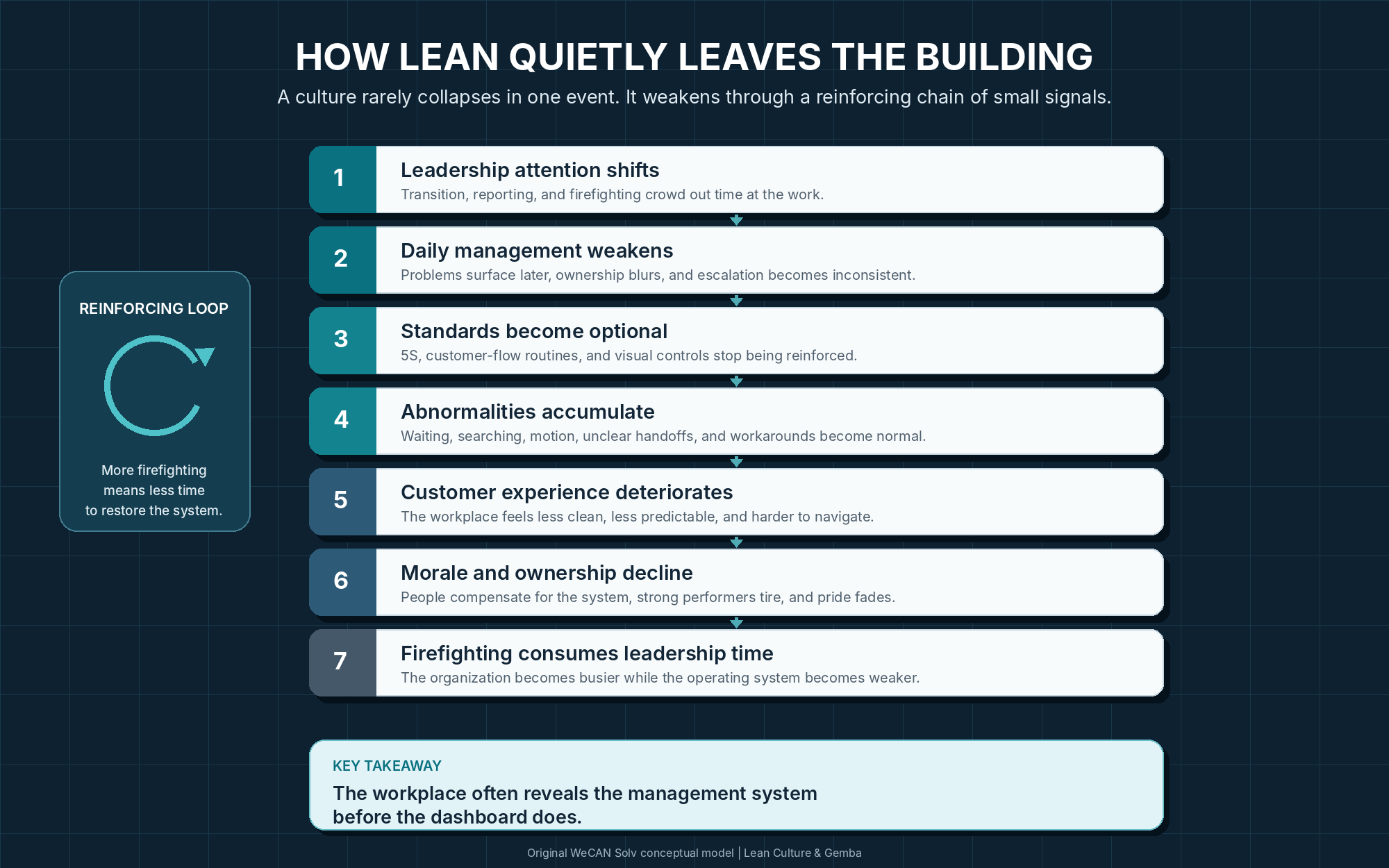
The most striking part was not any single defect.
It was the accumulation of small signals:
- cleanliness no longer receiving the same attention;
- customer arrival becoming more reactive;
- roles and handoffs appearing less clear;
- employees walking, waiting, or searching;
- visible busyness without visible flow;
- lower energy and weaker morale;
- abnormalities remaining in place long enough to look normal.
None of these observations, by itself, proves that a business is failing.
Together, however, they tell you something about the operating system.
A Lean culture rarely disappears through one dramatic decision.
It fades through hundreds of small moments when standards are no longer reinforced, abnormalities are no longer challenged, and leaders become too consumed by transition or firefighting to protect the way work is managed.
More people do not always mean more capacity
One of the most misleading assumptions in service operations is that adding people automatically adds capacity.
It does not.
When roles, priorities, and handoffs are unclear, more people can create more motion, more interruptions, more overlapping responsibility, and more opportunities for work to fall between functions.
Lean asks us to distinguish activity from value.
Movement is not the same as flow.
Busyness is not the same as productivity.
Headcount is not the same as capacity.
A well-designed process makes clear:
- what work is expected;
- where the work goes next;
- who owns the next action;
- what condition requires escalation;
- what the customer should experience;
- how the team reviews the day while there is still time to recover it.
Without that clarity, additional staffing may hide the underlying problem. Employees spend their time compensating for a weak system.
The workplace is a leadership signal
A disorganized workplace is rarely only a housekeeping problem.
It may reveal unclear ownership.
Excess movement may reveal poor layout, missing point-of-use storage, or unstable work allocation.
Idle time may reveal coordination problems rather than a lack of effort.
Customer confusion may reveal that the process has drifted toward internal convenience instead of customer flow.
These conditions are easy to dismiss because each one appears small.
But small conditions teach people what leadership considers normal.
Employees notice which standards are reinforced.
They also notice which standards can be ignored.
The evidence is broader than one dealership
My story is personal, but the wider signals are not unique.
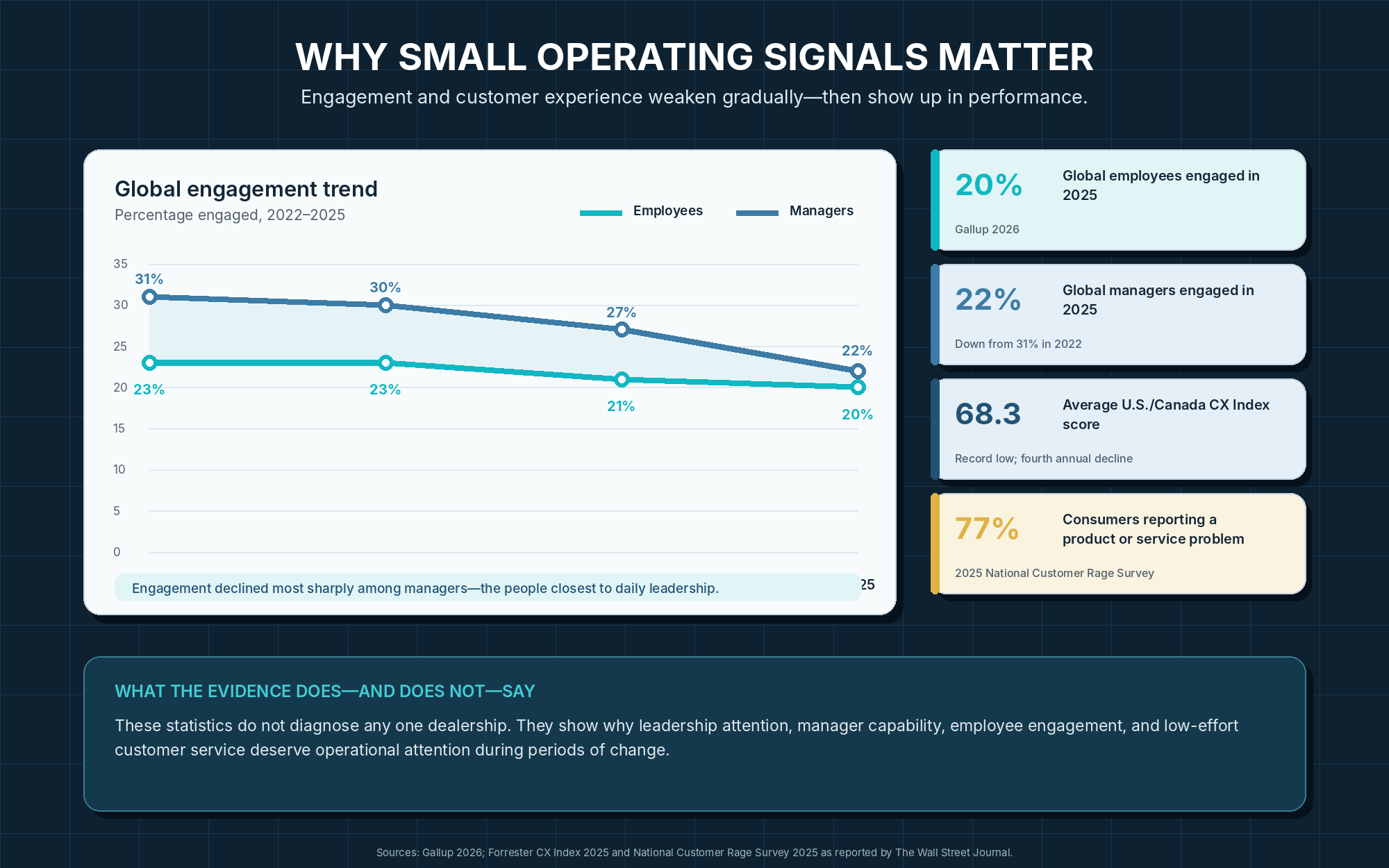
Gallup’s 2026 State of the Global Workplace report found that global employee engagement fell to 20% in 2025, while manager engagement fell to 22%, down from 31% in 2022. Gallup also found that manager engagement in best-practice organizations was 79%, showing that low engagement is not inevitable.1
Customer-experience research points in the same direction. The 2025 Forrester Customer Experience Index for the United States and Canada fell to a record-low average of 68.3 out of 100, its fourth consecutive annual decline. In the 2025 National Customer Rage Survey, 77% of consumers reported experiencing a product or service problem in the previous year.2
Automotive service operations have their own pressures. J.D. Power’s 2023 U.S. Customer Service Index study, based on 64,248 verified owners and lessees, reported longer appointment waits amid technician shortages and increasing repair complexity.3
These statistics do not diagnose the dealership I know.
They show why leadership attention, manager capability, employee engagement, customer effort, and service flow deserve serious attention—especially during periods of ownership or organizational change.
Gemba is not a ceremonial walk
My reaction to the dealership did not come from a formal audit.
It came from using the operation repeatedly over many years and noticing the difference between what the process once enabled and what customers and employees now appeared to experience.
That is the practical value of gemba.
Gemba is not walking around to inspect people.
It is going to the place where value is created and learning to see:
- where work waits;
- where employees search;
- where customers become uncertain;
- where standards help;
- where workarounds have become routine;
- where leaders receive information too late;
- where the system asks good people to compensate for poor design.
This is the discipline behind the emerging GembaWise concept: observe the real work, interpret the signals carefully, and ask better questions before prescribing solutions.
The important word is carefully.
A gemba observation is evidence.
It is not the entire diagnosis.
Lean does not leave all at once
Lean does not leave the building when one floor marking fades.
It does not disappear because a visual board is out of date.
It leaves when the routines behind those tools stop mattering.
It leaves when leaders no longer ask what is abnormal.
It leaves when employees are expected to work around problems instead of helping solve them.
It leaves when customer confusion becomes accepted.
It leaves when the workplace is allowed to communicate indifference.
The change may be gradual.
Customers feel it.
Employees feel it.
Eventually, the business results feel it too.
The good news is that a weakened improvement culture is not necessarily lost forever.
But bringing it back requires more than another cleanup day or kaizen event.
It requires leaders to reconnect with the work, stabilize the basics, rebuild daily management, and turn what they observe into disciplined improvement.
That is where Part 2 begins.
Sources
- Gallup. State of the Global Workplace 2026. Global employee engagement was 20% in 2025; manager engagement was 22%; manager engagement in best-practice organizations was 79%.
- The Wall Street Journal reporting on Forrester’s 2025 Customer Experience Index and the 2025 National Customer Rage Survey.
- Axios reporting on J.D. Power’s 2023 U.S. Customer Service Index study of 64,248 verified vehicle owners and lessees.
Evidence boundary
The personal narrative is based on the author’s experience and observation. It is not presented as a controlled study, client case study, financial assessment, or claim that ownership transition alone caused the conditions described. The dealership, owners, employees, city, brand, and specific operating data remain intentionally undisclosed.