A Kaizen event can accelerate learning and change. It cannot, on its own, substitute for the management system required to keep that change alive.
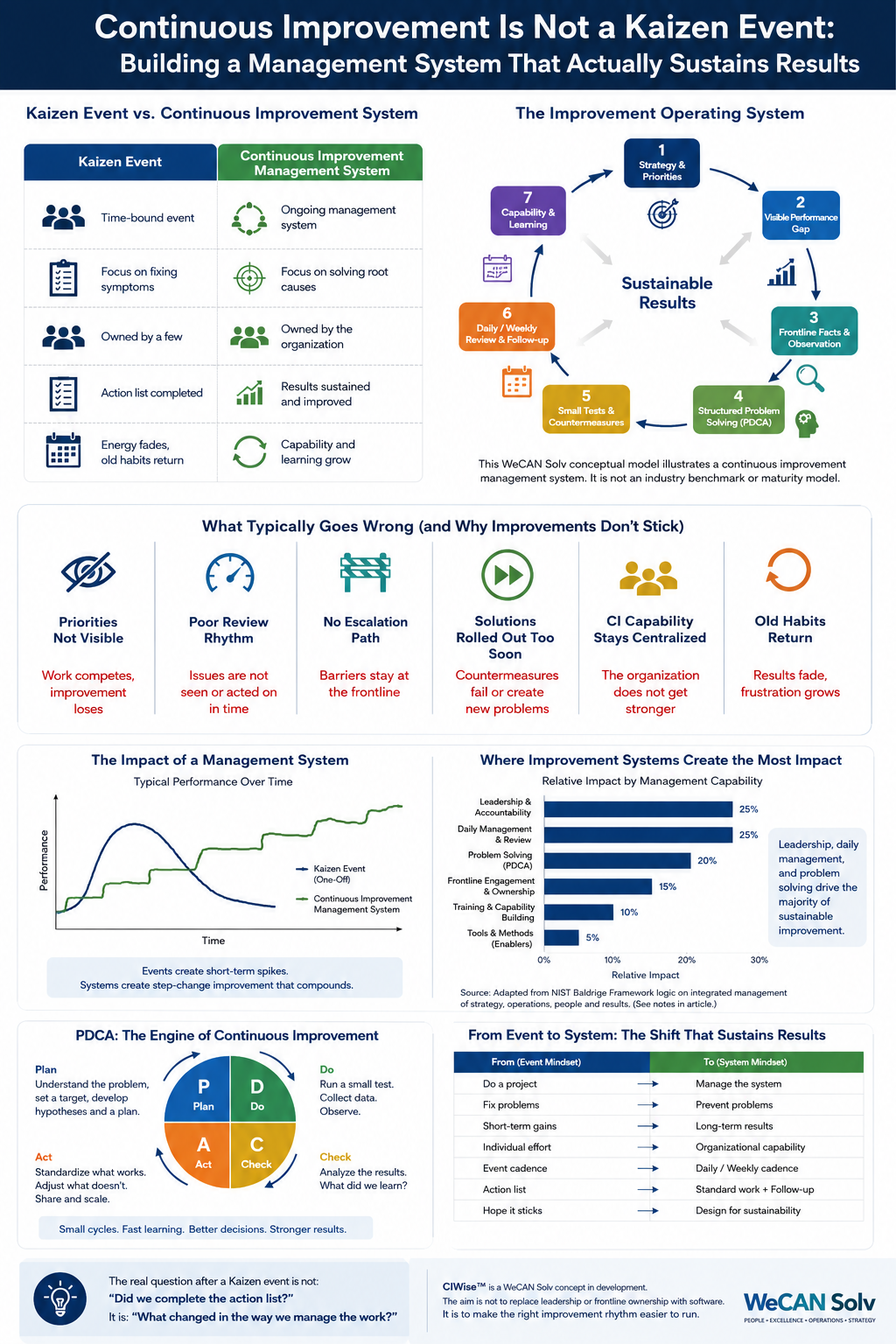
When the event ends, the real test begins
Friday afternoon: the workshop finishes with a wall full of ideas, a sharper process map, several committed owners, and a real sense that the team has finally turned a corner.
Six months later, much of the old pattern has returned. The action list is no longer visible. The new standard is used inconsistently. The same barriers reappear. People quietly conclude that the improvement “did not stick.”
That outcome is often blamed on weak execution or a lack of employee engagement. Sometimes those are part of the story. More often, the deeper issue is simpler: the event changed; the management system did not.
A Kaizen event, value-stream map, root-cause session, or dashboard can be useful. Each can help a team see a problem, organize facts, and make a change. But none of them, by itself, creates the leadership routines, feedback loops, escalation paths, capability, and follow-through that sustain better work.
Improvement has to be managed as a system
This is not just Lean language. Major performance-management frameworks treat improvement as an integrated operating responsibility rather than a disconnected project.
ISO’s explanation of ISO 9001:2015 links the process approach, risk-based thinking, and the Plan–Do–Check–Act cycle to managing processes and the management system as a whole. It also connects the quality management system to strategic planning and business processes.[1]
The Baldrige Excellence Framework takes the same systems view. Its categories span leadership, strategy, measurement and knowledge management, workforce, operations, and results. It assesses processes not only by their design, but by deployment, learning, and integration across the organization.[2]
In plain language: an improvement is not fully implemented when the workshop ends or the action is marked complete. It is implemented when the new approach is used, reviewed, learned from, and connected to the goals that matter.
- 1Strategy & priorities
- 2Visible performance gap
- 3Frontline observation & facts
- 4Structured problem solving
- 5Small, testable changes
- 6Daily / weekly review & escalation
- 7Standard work, capability & learning
What the operating model makes visible
The model begins with strategy because improvement capacity is limited. Teams can solve many local irritations and still fail to improve the business problem that matters most. A management system must make priorities visible and turn them into specific performance gaps.
It then moves to frontline observation and facts. The work itself—not a polished explanation of the work—is the starting point. This is where leaders and teams see actual handoffs, constraints, rework, waiting, unclear information, and competing demands.
Structured problem solving follows. PDCA matters not because the four letters are magic, but because it asks teams to make their assumptions visible: What do we think is happening? What change are we testing? What result do we predict? What evidence will tell us whether to continue, adapt, or stop?
A systematic review of PDSA applications found that iterative cycles, small-scale testing, prediction-based change, and use of data over time were key features of the method—and that these features were often incompletely applied in published practice.[4] The lesson for operations is humble but important: declaring an action complete is not the same as learning whether the action works.
Daily and weekly management turns learning into operating rhythm. In one published description of Lean daily management, the system is designed to make problems visible quickly, enable frontline resolution where possible, and escalate issues that require broader support; the described elements include leadership standard work, visual controls, and a daily accountability process.[5]
Five design questions for leaders
1. What business problem are we trying to improve?
Start with a real performance gap—not a tool selection. The better question is not, “Which Lean tool should we use?” It is, “What result matters, what is the current condition, and what is keeping us from closing the gap?”
2. Where do the facts come from?
Go to the work. Observe the conditions. Ask the people who perform the work what makes good performance difficult. Compare the designed process with the actual process. Separate facts, assumptions, and interpretations.
3. What is the smallest safe experiment that can test the idea?
Do not jump from diagnosis to full rollout whenever a smaller test can produce useful evidence. Define the change, the expected result, the scope, the review measure, and the decision rule for continue, adapt, standardize, or stop.
4. What cadence keeps the work visible?
The exact frequency must fit the operating environment. The principle is the same: performance and learning must be visible frequently enough to change decisions.
5. Who is becoming more capable because of this work?
A central CI team can accelerate change. It cannot be the sole owner of improvement. Sustainability research in Lean management—primarily in healthcare contexts—identifies workforce involvement, leadership follow-through, local change support, training, and improvement culture as important facilitators; it also identifies weak follow-through, insufficient capacity, and exclusion of staff as barriers.[3]
Technology has a role—but it is not the management system
Technology can reduce friction around good management habits: capturing observations close to the work, making measures and actions visible, creating a reliable escalation trail, preserving decisions and lessons, and helping leaders see where support is needed.
But a dashboard cannot substitute for leadership. An app cannot substitute for ownership. AI cannot substitute for clear problem definition and disciplined review.
The CIWise™ principle
CIWise™ is a WeCAN Solv concept in development. The intent is to make a sound continuous-improvement rhythm easier to run, more visible, and more sustainable—without replacing leadership, frontline ownership, or thoughtful problem solving.
Limits and caveats
- Kaizen events can be highly effective when they are tied to an ongoing operating system.
- PDCA is a disciplined learning approach, not a guarantee of results.
- The cited Lean-sustainment and daily-management studies include healthcare settings; their findings should be adapted thoughtfully rather than transplanted into another sector.
- The CI operating-system figure is an original WeCAN Solv conceptual model, not an empirical maturity model.
- No client, employer, operational, or proprietary data is used in this article.
The harder closeout question
The next time an improvement event finishes, do not ask only, “Did we complete the action list?”
Ask a harder and more useful question:
If the answer includes clearer priorities, stronger observation, disciplined experiments, visible measures, reliable escalation, better coaching, and learning built into the rhythm of work, the improvement has a chance to last.
If the answer is only “we held a workshop,” the organization has completed an event—not built a management system.
Sources and notes
- International Organization for Standardization. Giving ISO 9001 a fresh sparkle (2015). Read source.
- National Institute of Standards and Technology, Baldrige Performance Excellence Program. About the Baldrige Excellence Framework (updated 2023). Read source.
- Kunnen, Y. S., Roemeling, O. P., & Smailhodzic, E. (2023). What are barriers and facilitators in sustaining lean management in healthcare? A qualitative literature review. BMC Health Services Research, 23, 958. Read source. Transferability note: healthcare evidence; informs but does not prove conclusions for other sectors.
- Taylor, M. J., et al. (2014). Systematic review of the application of the plan-do-study-act method to improve quality in healthcare. BMJ Quality & Safety, 23(4), 290–298. Read source. Transferability note: cited for the discipline of iterative, small-scale, data-informed testing.
- Donnelly, L. F. (2014). Daily Management Systems in Medicine. RadioGraphics, 34(2). Read source. Transferability note: illustrative daily-management design from healthcare, not a universal implementation template.