Lean is often introduced through visible tools: 5S, value-stream maps, A3s, standard work, visual boards, and Kaizen events. Those tools matter. But they do not create improvement by themselves.
The quieter foundation is dialogue: the disciplined conversation through which people describe what they see, distinguish facts from assumptions, make barriers visible, decide what to try next, and learn from the result.
Without that, Lean becomes a communication cascade. Leaders send direction. Teams provide status. Meetings review slides. Problems surface late. The work continues, but the learning loop is weak.
People cannot improve work they are not allowed to discuss honestly—and leaders cannot remove barriers they have not learned to see.
Dialogue is not endless discussion. It is not consensus theatre. It is a practical operating habit that connects purpose, process, people, and action.
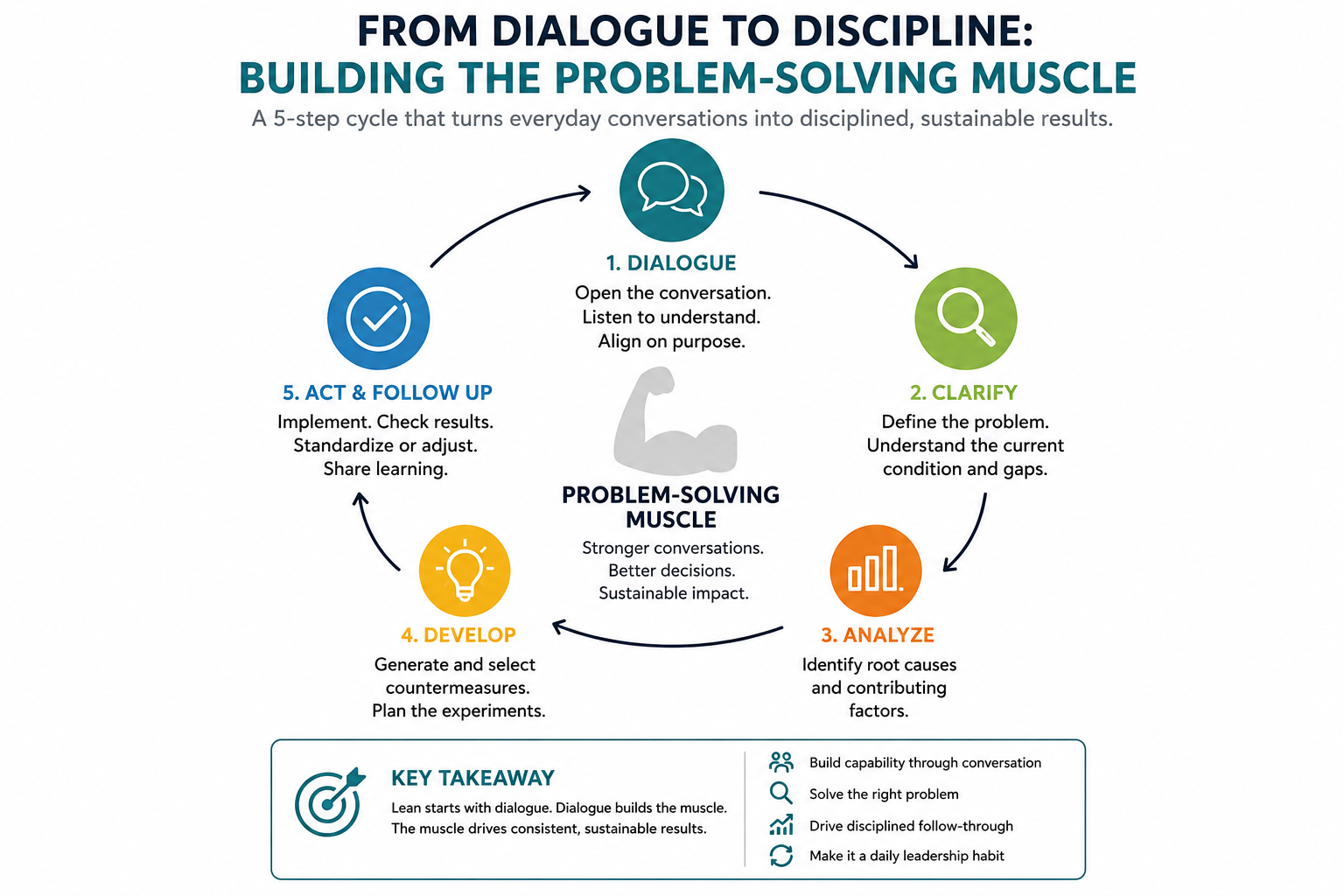
From Dialogue to Discipline: Building the Problem-Solving Muscle
This original WeCAN Solv conceptual model is not a benchmark or maturity score. It shows how everyday dialogue can become a repeatable learning and action loop.
Communication is not the same as dialogue
Most organizations communicate constantly. They issue priorities, dashboards, updates, newsletters, instructions, and meeting minutes. That does not mean the organization has a healthy dialogue system.
Communication can be one-way: information moves from a leader to a team. Dialogue requires movement in both directions. People closest to the work are able to describe what is happening, explain where the process is difficult, and raise conditions that require support beyond their authority.
That distinction matters because operational work is full of local knowledge: a recurring delay, a workaround nobody has formally recorded, an unclear handoff, a tool that does not match the job, or a measure that pushes the wrong behaviour. Those details rarely appear in a leadership deck by themselves.
ISO’s quality-management principles link leadership with conditions in which people are engaged, and explicitly encourage collaboration, open discussion, knowledge sharing, and the authority to identify constraints to performance. [1] In the Baldrige framework, senior-leader communication is described as supporting two-way dialogue and high performance. [2]
Dialogue begins where the work happens
In Lean practice, the gemba is the place where value-creating work occurs. Going there is not a leadership tour. It is a way to replace assumptions with observation.
A useful gemba conversation does not begin with, “Why are you behind?” It begins with questions that make the work visible:
The Lean Enterprise Institute’s “go see, ask why, show respect” framing is useful here: observation should connect purpose, process, and people—not turn into a search for someone to blame. [3]
Five questions that improve the quality of the conversation
Leaders do not need to become silent. They need to stop giving the answer before the problem has been understood.
- What should be happening? Establish the expected condition, standard, target, or customer need.
- What is happening now? Describe the actual condition using direct observation, data, or a specific example.
- What is making the gap difficult to close? Bring obstacles, handoffs, and constraints into the conversation.
- What have we already tried—and what did we learn? Prevent the team from repeating unexamined activity.
- What support or decision is needed next? Clarify whether the barrier is local, cross-functional, or leadership-owned.
These questions are simple on purpose. They create a common fact base before people debate causes or solutions.
Dialogue belongs in daily management—not only in workshops
Many organizations have excellent conversations during a Kaizen event, A3 review, annual planning session, or leadership offsite. The difficulty is carrying that quality of inquiry into normal work.
Daily management is where dialogue becomes an operating rhythm. A short, well-run routine can make performance visible, distinguish a normal variation from an abnormal condition, enable the team to act locally, and route barriers to the right level quickly.
The visual board is not the point. The board is a shared fact base. The point is the conversation around it:
- What changed since yesterday?
- What is the most important gap?
- What is within the team’s control today?
- What must be escalated?
- What will we check before the next review?
This is why visual management and dialogue belong together. A visible measure without a response routine is decoration. A discussion without visible facts can become opinion. Together, they create a workable loop.
Catchball turns direction into shared ownership
Dialogue also matters above the frontline. In strategy deployment, leaders may set a direction, but the people responsible for execution often understand the conditions, dependencies, and trade-offs that will determine whether it can work.
Catchball is not simply asking people to “buy in.” It is the discipline of passing intent, facts, questions, and counter-proposals back and forth until the work is both aligned and workable.
That does not mean every decision is democratic. Leaders still make decisions. But good leaders invite the information that makes a decision more realistic and the ownership that makes execution more durable.
What leaders do that shuts dialogue down
Most leaders do not set out to silence people. Yet a few common habits make honest operational dialogue less likely:
- Asking for status before asking what the team sees.
- Correcting the first person who raises a difficult issue.
- Demanding solutions from teams that do not control the constraint.
- Treating escalation as failure rather than useful information.
- Returning to the same problem without reporting what happened to the last request.
- Using a gemba walk to audit compliance rather than understand work.
The effect is predictable: people learn which problems are safe to mention and which ones are better handled through private workarounds.
A 10-minute dialogue routine
Start small. Before the workday, during a tier meeting, or at a visual board, use this simple routine:
- Purpose: State the most important outcome or condition for the period.
- Facts: Review what changed—not every metric, only the meaningful signal.
- Gap: Name the most important abnormal condition.
- Support: Ask what the team can act on and what needs help.
- Follow-through: Confirm one next step, one owner, and when the loop will be closed.
That routine will not solve every problem. It will do something more foundational: it will make work easier to see, help people use evidence rather than hierarchy, and turn daily management into a habit of learning.
Technology can strengthen the dialogue—but cannot replace it
Digital systems can reduce friction. They can make observations easier to capture, surface patterns across teams, preserve action history, and make follow-through more visible.
But an app does not create trust. A dashboard does not remove a barrier. AI does not decide whether a leader has listened well or whether a team’s concern needs action.
That is the principle behind the WeCAN Solv concepts in development. CIWise™ is intended to make improvement work, follow-through, and learning easier to see. HoshinWise™ is intended to help connect strategic intent, execution alignment, review rhythm, and learning. Neither replaces leadership, frontline ownership, or disciplined dialogue.
The question to keep
Lean does not begin when someone launches a tool.
It begins when a leader creates enough clarity, respect, and factual discipline for people to say what is actually happening—and when the organization responds to what it learns.
Before asking, “What actions are on the list?” ask: “What did we learn from the work today—and what will change because of it?”
Better questions create better conversations. Better conversations create a stronger fact base. And that is where better improvement begins.
Sources and notes
- International Organization for Standardization. Quality management principles. Leadership and engagement of people sections.
- National Institute of Standards and Technology, Baldrige Performance Excellence Program. 2023–2024 Baldrige Excellence Framework: Criteria Commentary. The cited document is health-care specific; it is used here for its broadly applicable leadership and two-way-dialogue principle.
- Lean Enterprise Institute. How to Go to the Gemba: Go See, Ask Why, Show Respect.
- Lean Enterprise Institute. What kind of conversation should I expect during a gemba walk?.
Evidence boundary: This article is a practical synthesis for operational leaders. It does not prescribe a universal meeting design or claim that dialogue alone improves performance. The Dialogue-to-Improvement Loop is an original WeCAN Solv conceptual model, not a validated maturity assessment.
Making improvement easier to run
WeCAN Solv is developing practical frameworks, content, and future digital tools for operational excellence, strategy deployment, maintenance performance, decision support, and organizational learning.
Start a conversation