A low bid can be expensive. A strong business case can still hide weak assumptions. A valuation model can look precise while leaving the real decision unresolved.
This happens because many high-stakes commercial decisions are compressed into one visible output: a price, a score, a net present value, a ranking, or a recommendation slide.
Those outputs matter. But they are not the decision.
A contracting strategy, bid/no-bid decision, acquisition screen, outsourcing choice, major supplier selection, or project delivery strategy is rarely only an economic question. It is also a question of strategic intent, scope clarity, market reality, technical and operational fit, risk exposure, execution readiness, and governance.
When those layers are mixed together, teams can end up debating the wrong thing.
Why the stakes are high
This is not just a theoretical issue. Commercial decisions move large amounts of value, risk, and organizational attention.
A few numbers put the problem in perspective
- Across OECD countries, public procurement expenditure increased from 11.8% of GDP in 2007 to 12.9% of GDP in 2021.
- In 2021, 61.2% of OECD countries’ procurement spending remained at the sub-national level, where local execution and governance strongly affect outcomes.
- OECD reporting also notes that public infrastructure investment should reach about USD 71 trillion by 2030.
- In mergers and acquisitions, BCG data reported by Reuters showed global M&A activity of about USD 1.938 trillion in the first nine months of 2025, still more than 40% below the 2021 peak.
The lesson is not that every organization needs a complicated decision process. The lesson is that commercial decisions carry enough money, risk, and execution consequence that the thinking should not be compressed into one number too early.
The trap: reducing a commercial decision to one number
Commercial decisions become fragile when the conversation collapses into one comparison.
Lowest price. Highest score. Best NPV. Fastest schedule. Preferred bidder. Most familiar supplier. Strongest strategic story.
Each may contain useful information. None is enough by itself.
A low price may carry hidden execution risk. A strong NPV may depend on assumptions that operations cannot deliver. A technically attractive option may have poor commercial alignment. A supplier with strong capability may not fit the contracting model. An acquisition may look attractive financially while creating integration work the organization is not ready to absorb.
The issue is not that financial models, bid evaluations, or recommendation slides are wrong. The issue is that they often combine unlike questions into one answer.
One group argues about economics. Another worries about capability. Operations questions whether the scope is executable. Supply chain sees market constraints. Legal sees risk allocation that may not hold in practice. Leadership wants speed. The decision becomes noisy because the layers have not been separated.
What a business case can and cannot do
A good business case is valuable. It clarifies the need, the options considered, the expected value, the implementation approach, and the evidence behind a recommendation. Formal appraisal guidance also treats option appraisal as more than a cost exercise: it includes costs, benefits, and risks of different options for achieving objectives.
But a business case is still a container. It can hold good thinking or weak thinking.
The document may look complete while the decision remains underdeveloped. A polished business case can still hide unclear scope, untested assumptions, missing stakeholder alignment, weak contracting logic, or an execution pathway that has not been stress-tested.
That is why better commercial decisions need a layered view before approval. The question is not simply, “Is the business case complete?”
The better question is:
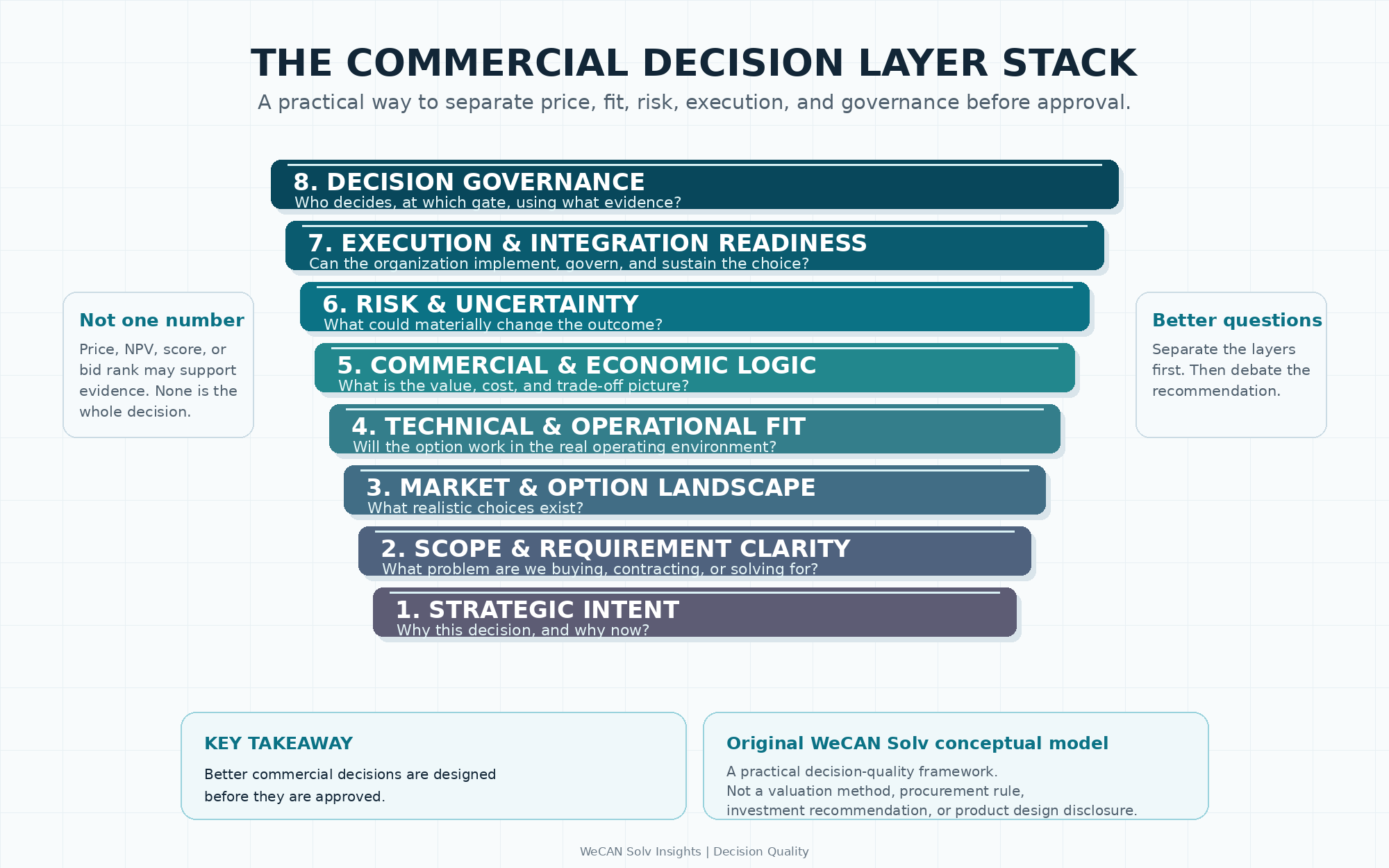
The Commercial Decision Layer Stack
The layer stack is not a procurement procedure, valuation model, or software design disclosure. It is a practical way to make a decision conversation more disciplined.
For a contracting strategy, bid/no-bid decision, contractor selection, acquisition screen, outsourcing choice, or other major commercial decision, the layers help teams avoid mixing fundamentally different questions.
Layer 1: Strategic intent
Before evaluating options, clarify why the decision exists.
Is the organization trying to reduce cost, access capability, improve reliability, accelerate delivery, enter a market, protect capacity, transfer risk, create optionality, or simplify the operating model?
Strategic intent matters because the same option can look good or bad depending on the real objective. A contracting model that supports speed may not support long-term capability building. A low-cost supplier may not support resilience. An acquisition may create growth but increase integration complexity.
A practical question:
What outcome would make this decision successful three years from now?
Layer 2: Scope and requirement clarity
Many commercial decisions fail before the market is even engaged because the scope is unclear.
The organization may be buying a service, but the real need is reliability. It may be contracting labour, but the real need is execution capacity. It may be evaluating a bidder, but the real problem is an incomplete requirement. It may be screening an acquisition, but the real question is whether the asset or business fits the strategic constraint.
When scope is unclear, price comparisons become misleading. Suppliers price different interpretations. Internal stakeholders evaluate different expectations. Delivery teams inherit gaps that were never resolved.
A practical question:
What problem are we really buying, contracting, or solving for?
Layer 3: Market and option landscape
A decision should not assume that the preferred option is the only realistic option.
Teams need to understand the market, supply capacity, capability availability, competitor dynamics, contracting norms, timing constraints, and the difference between theoretical options and executable choices.
For contracting and bidding, this includes whether the market can respond to the scope, whether the evaluation approach will attract the right bidders, and whether the organization is asking the market to carry risks it cannot reasonably control.
For acquisition or outsourcing, it includes whether the available options actually match the strategic intent or simply appear convenient because they are visible.
A practical question:
What realistic choices exist, and what choices are we pretending exist?
Layer 4: Technical and operational fit
Commercial logic has to survive contact with the work.
An option can look attractive in a model and still fail in the operating environment. Technical capability, maintainability, field constraints, workforce readiness, interface complexity, schedule realism, data quality, and operating discipline all matter.
This is where decision quality connects to operational excellence. The commercial decision is not only “Can we buy it?” or “Can we award it?” It is also “Can we make it work?”
A practical question:
Will this option work in the real operating environment, not just in the evaluation table?
Layer 5: Commercial and economic logic
Economics still matter. Price, cost, cash flow, benefits, margin, schedule exposure, value creation, and trade-offs must be visible.
The point is not to reduce the importance of financial analysis. The point is to prevent the financial view from carrying questions it was not designed to answer.
A bid evaluation may compare price and technical score. A business case may compare options. A valuation may estimate economic attractiveness. But each depends on assumptions: volume, productivity, timing, integration cost, risk treatment, market response, operating performance, and benefit capture.
A practical question:
Which assumptions drive the economics, and who owns the evidence behind them?
Layer 6: Risk and uncertainty
Risk is not a paragraph near the end of the business case.
It is part of the decision.
Commercial risk includes market risk, delivery risk, contract risk, performance risk, integration risk, regulatory exposure, supplier risk, stakeholder risk, and assumption risk. Some risks can be transferred. Some can only be shared, retained, reduced, monitored, or priced. Some risks are created by the contracting model itself.
Good decision work asks not only, “What could go wrong?” but also, “What uncertainty could change the decision?”
A practical question:
What would have to be true for this recommendation to become the wrong choice?
Layer 7: Execution and integration readiness
Approval is not the finish line.
A commercial decision creates work: contract management, mobilization, integration, governance, performance review, stakeholder alignment, change control, issue escalation, and benefits capture.
This is where many strong recommendations lose value. The organization approves the decision but underestimates the execution system required to make it real.
For contracting, this may mean the contract is awarded but the owner team is not ready to manage performance. For outsourcing, it may mean the service provider takes responsibility while the retained organization loses critical knowledge. For acquisition, it may mean value capture depends on integration work that was never fully resourced.
A practical question:
Can we implement, govern, and sustain the decision after approval?
Layer 8: Decision governance
The final layer is governance: who decides, at which gate, using what evidence, and with what accountability.
Decision governance is not bureaucracy when it is designed well. It prevents late surprises, unclear authority, shifting criteria, hidden assumptions, and political rework.
The best governance does not simply ask whether the recommendation has been approved. It asks whether the evidence is sufficient for the type of decision being made.
A practical question:
What evidence would give the decision makers enough confidence to proceed, pause, or change course?
A practical leadership question set
Leaders do not need to turn every decision into a large workshop. Even a short review can improve decision quality if the layers are visible.
- What is the decision we are actually making?
- What is the strategic intent?
- What scope or requirement is still unclear?
- What options were considered and why were some rejected?
- What assumptions drive the commercial case?
- What risks could materially change the outcome?
- What must be true operationally for the decision to work?
- Who owns execution after approval?
- What evidence would cause us to stop, redesign, or choose differently?
These questions are simple. They are also uncomfortable when a decision has been rushed into a recommendation before the thinking is ready.
Better decisions are designed before they are approved
The best commercial decisions are not just approved. They are designed.
They separate the layers before collapsing them into a recommendation. They make assumptions visible. They test the fit between strategic intent and operational reality. They treat risk as part of the decision rather than a late add-on. They ask whether the organization can execute the choice after the meeting ends.
A business case is still needed.
A bid evaluation is still needed.
A valuation model may still be needed.
But none of them should carry the full weight of the decision alone.
Public-safe WeCAN Solv note
At WeCAN Solv, this kind of thinking informs future decision-support concepts such as DecideWise™, where structured evaluation and transparent trade-off logic can help leaders make complex choices more visibly. This article shares a public conceptual framework only. It does not disclose product design, scoring logic, templates, commercial evaluation methods, or controlled internal work.
Sources and notes
- HM Treasury. The Green Book. UK government guidance on appraisal; describes appraisal as assessing the costs, benefits, and risks of different options for achieving objectives.
- HM Treasury. Guidance on developing business cases. Sets out the step-by-step process for developing business cases for projects and programmes based on the Five Case Model.
- HM Treasury. Green Book supplementary guidance: multi-criteria decision analysis. Provides guidance on applying MCDA in options appraisal, including when to use it, the general approach, key considerations, and common pitfalls.
- World Bank Group. Project Procurement. Describes procurement strategy and planning guidance focused on value for money, efficiency, transparency, fairness, and project impact.
- OECD. Public procurement. Provides context on procurement scale, risk, value for money, sub-national spending, and the economic significance of procurement decisions.
- Reuters / Boston Consulting Group. Global M&A activity up 10% in first nine months of 2025, study shows. Used only as market context for the scale and cyclicality of acquisition decisions.
- International Organization for Standardization. ISO 31000:2018 Risk management — Guidelines. Provides principles and guidelines for risk management and emphasizes integration with governance, strategy, planning, reporting, and decision-making.
Evidence boundary: This article is a practical synthesis for operational and commercial leaders. The Commercial Decision Layer Stack is an original WeCAN Solv conceptual model, not a valuation method, procurement rule, investment recommendation, legal advice, or product design disclosure.